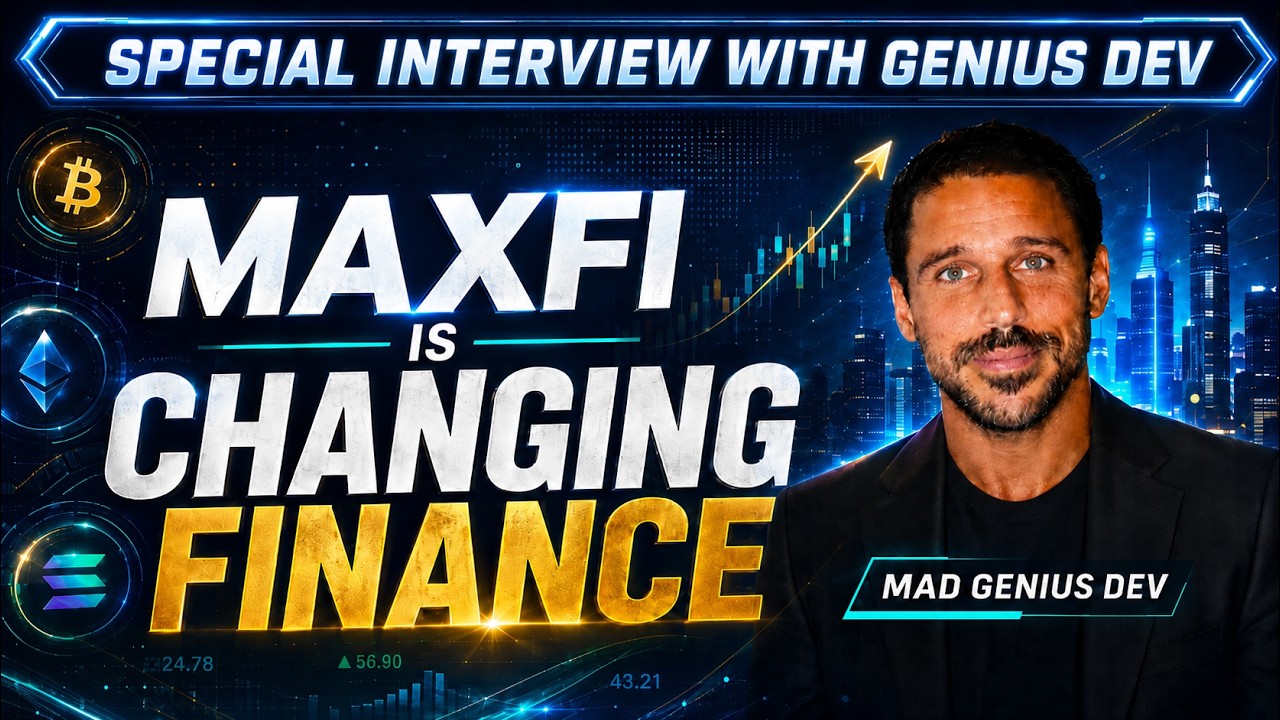
MaxFi Explained by DAO King: No-Swap Rebalancing, AI Time Delays, Agent Max's Pool Picks, and the 4-Year Cycle Setup
DAO King walks through the four MaxFi features that quietly do the heavy lifting on every position — the no-swap rebalancing engine that removes swap fees, slippage, price impact, MEV, and 40-50% of the realized impermanent loss per rebalance compared to the 50/50 swap-based path; the rebalance delay that turns out-of-range wicks into 'zero impermanent loss' events; Agent Max's intelligence layer with explicit cover ratios over IL; and the Bitcoin 4-year cycle positioning thesis that puts the current bear-window bottom roughly 3-4 months away. Real numbers throughout: $1,300 swap that cost $10, $2,400 saved on a $5K pool over 60 rebalances per year, $14K growing to $58K in one year or $180K in two on the SOL/WETH accumulator math, 3.38x and 3.87x cover ratios on real Agent Max picks, and the exact aggressive / moderate / conservative settings Agent Max recommends across SOL/WETH, ETH/BTC, WETH/VVV, and VIRTUAL/WETH.
Chapters
- 0:00DAO King opens: the four MaxFi features this video covers
- 1:25Section 1: The no-swap rebalancing technology explained
- 2:10DAO King's real swap: $1,300 cost roughly $10 in fees on a major pool
- 3:13Asking the AI to model the true year-over-year savings
- 4:11The competitor that copied the system and got demolished by 30-50% annualized
- 4:34$5,000 pool, 60 rebalances per year: $2,400 saved net
- 5:55How no-swap compounding folds matching-token rewards back into the position
- 7:18Section 2: The rebalance delay (the most-misunderstood feature)
- 8:27Alex's Discord explanation — out-of-range is a feature, not a bug
- 10:34DAO King's recent SOL/WETH story: 60-70% of positions went out of range, all back in 2-3 hours
- 11:40The 52-hour delay that hasn't rebalanced on a SOL price wick
- 12:43Why reflexive rebalancing at a wick peak guarantees more impermanent loss
- 13:50Section 3: Cover value — the intelligence layer no one else has
- 14:503.38x and 3.87x cover on SOL/WETH explained in dollar terms
- 15:42Aggressive setting: 2% wide range, 19.46% IL, 2.34x cover
- 16:08Moderate setting: 4% wide, 12% IL, 138% fees, 3.38x cover
- 17:14Conservative setting: 40% wide, near-zero IL, 31% fees, 50x cover
- 17:40Why $100K of staked ETH earning $3K is worse than the same $100K LP'd at $30K
- 19:07PancakeSwap SOL/WETH at 3.1% wide — same accumulator math, second venue
- 19:39Section 4: Agent Max's pool picks (the new on-page upgrade)
- 22:30Why 1% fee tier pools destroy people on swap-based systems
- 22:55WETH/VVV settings: aggressive 2%/138h, moderate 12%/64h, conservative 40%/10h
- 24:34ETH/BTC settings: aggressive 0.2%/93h, moderate 2%/78h, conservative 19.7%/138h
- 25:54VIRTUAL/WETH settings: aggressive 1.5%/119h, moderate 28.4%, conservative 40%/11h
- 26:53Section 5: The Bitcoin 4-year cycle and where we are right now
- 27:42Last cycle: peak November 2021 → bottom November 2022 (360 days)
- 28:14FTX moment: BTC at $16K and 'Bitcoin going to zero' hysteria
- 29:18Nick O'Neill 'Choose Rich' is this cycle's Peter Zeihan peak-doomer moment
- 30:18This cycle: October 2025 top → projected October 2026 bottom (3-4 months out)
- 30:35Asymmetric cycles — lows lower, highs higher (BTC at trillion, ETH at $180B)
- 31:43DCA through the bottom window, compound the LP fees, position for 2027
- 33:18Outro: what DAO King is gunning for on his own positions
Key Takeaways
- ✓Swap fees, slippage, and price impact compound brutally on a swap-based LP. DAO King opened a $2,600 position and paid roughly $10 in fees on the $1,300 swap alone — and modelled out on a $5K pool with 60 rebalances per year, that adds up to $2,400 in pure friction. MaxFi runs a no-swap reposition every time, so that entire cost line is zero.
- ✓The compounding loop is no-swap too. When a SOL/WETH position earns 50/50 in LP fees and rebalances, the matching token portion gets folded back into the new position at the new range — no buy-in, no swap, no fees. The other half is air-dropped to the user's wallet. Same accumulator effect, zero swap drag.
- ✓The rebalance delay isn't a bug, it's the feature. DAO King watched 60-70% of his SOL/WETH positions go out of range during a SOL pump and didn't panic; they all came back into range within 2-3 hours, no rebalance ever fired, no impermanent loss locked in. A swap-based system would have rebalanced at the peak and again on the retrace, paying the swap stack twice for nothing.
- ✓Out-of-range is mathematically better than reflexive rebalancing. Alex's framing from the MaxFi Discord: rebalancing at the top of a wick guarantees more realized IL than waiting through the retrace. The delay is set by Agent Max per-pool — 4h, 9h, 52h, 138h — based on the pool's actual volatility footprint, not a one-size-fits-all setting.
- ✓Cover ratio is the metric most LP farmers don't even know exists. Agent Max prices every pool against impermanent loss explicitly: 3.38x cover on the SOL/WETH moderate setting means every $1 of IL is paid back 3.38 times in fees. On the conservative 40% wide setting where IL approaches zero, the cover ratio is 50x. The intelligence layer prices the trade-off — aggressive narrow ranges vs wide low-maintenance — instead of leaving it to guesswork.
- ✓Agent Max's pool picks are now wired into the deposit UI. SOL/WETH moderate: 4% wide / 9h delay / 138% fees / 3.38x cover. WETH/VVV moderate: 12% wide / 64h delay. ETH/BTC moderate: 2% wide / 78h delay. VIRTUAL/WETH moderate: 28.4% wide / shorter delay. Each one is the output of Optima sweeps across tens of thousands of range × delay combinations on real pool data.
- ✓The accumulator math on SOL/WETH at the conservative 75% APR target: $14K becomes ~$29K in one year if prices stay flat (you've just stacked tokens), $58K in one year if SOL/ETH each 2x, and $180K in two years if they each 3x in the cycle recovery. Some of DAO King's earlier positions are running 130%+ APR, so the conservative number is the floor, not the ceiling.
- ✓$100K of staked ETH earning 3% pays $3,000 a year. The same $100K split into a 40% wide SOL/WETH conservative LP at 31% APR pays $30,000 a year — with essentially zero impermanent loss because the range is so wide it almost never rebalances. The principal also rides the cycle upside since you're holding both legs of a correlated blue-chip pair.
- ✓The Bitcoin 4-year cycle bottom is roughly 3-4 months away. Last cycle: BTC top November 2021 → BTC bottom November 2022 (FTX-induced wick to $16K). This cycle: BTC top October 2025 → projected bottom around October 2026. DAO King's positioning move is to DCA in through the chop, compound the LP fees into more accumulators, and ride the asymmetric upside into 2027 — same playbook that produced his last cycle's wins.
- ✓Mass-hysteria signals are how DAO King calls the cycle bottom in real time. Last cycle that was Peter Zeihan on Joe Rogan saying BTC would go negative $1,000. This cycle it's Nick O'Neill ('Choose Rich') calling Michael Saylor a criminal headed for jail. The peak-doomer moment is the buying signal — DAO King's move while the doomers are screaming is to keep DCA'ing into accumulator pairs on MaxFi and let the LP fees compound through the bottom window.
The Four Features That Make Snuggle and MaxFi Game-Changers for LP Farmers
DAO King recorded this as a structured walkthrough — not an AMA, not a market take, but a real teaching pass through the four MaxFi features that quietly do the heavy lifting on every position. New users don't always understand which part of the system is doing the work for them, and experienced LP farmers coming from manual Uniswap or Aerodrome rebalancing don't always grasp how much friction they're leaving on the table by doing it the old way. This article tracks the video in the same order DAO King walks through it: the no-swap rebalancing engine, the rebalance delay, Agent Max's intelligence layer, and the Bitcoin 4-year cycle positioning thesis. Real numbers throughout, including DAO King's own recent positions and a $1,300 swap he personally paid fees on that triggered the whole framing.
MaxFi and Snuggle: Two Interfaces, One Protocol
A quick orientation note since both names come up in the video. MaxFi is built directly on Snuggle's smart contracts and uses Snuggle's no-swap rebalancing technology; Alex developed and owns both. The vault architecture, no-swap rebalancing engine, keeper integration, and 50/50 auto-compounding logic are identical between the two — they are the same Snuggle contracts underneath. The interfaces differ in pool curation, branding, and audience, but every strategy, preset, and result below applies the same on maxfi.tech as on Snuggle. When the article references "MaxFi and Snuggle" together it's because the conclusion holds for both. When it singles one out (MaxFi for the staked rewards flavor of a given pool, Snuggle for the auto-compounding flavor of the same pool), it's a deliberate distinction about pool curation, not the underlying tech.
Section 1: No-Swap Rebalancing — The $2,400-Per-Year Feature
DAO King opened the segment with a recent personal example. He was opening a $2,600 position and had $1,300 sitting in USDC that he needed to convert into the position's two-sided allocation (SOL and WETH). The swap quote on a major pool: roughly $10 in total cost — swap fees + slippage + price impact stacked. Looking at the breakdown on the swap interface, the cost was significantly higher than he'd assumed. On a single $1,300 swap. And that's a cheap case on a deep pool with reasonable slippage tolerance.
The compounding effect is what makes this matter. If you're running a $5,000 LP position on a swap-based platform and rebalancing roughly 60 times a year (which DAO King notes is conservative — some tight-range positions rebalance 30 times in a single month), the friction stack adds up to roughly $2,400 in total annual cost purely in swap-related fees. On a $20,000 position the math runs $3,400 (conservative) to $5,200 a year. On a deep-pocket position like DAO King's own (~$50,000 across MaxFi), the friction line eclipses $10,000 in some scenarios.
MaxFi rebuilds the position at the new range without ever touching the AMM through a swap. The vault re-deposits the same liquidity at new tick bounds. No swap fees because no swap happened. No slippage because no price was quoted. No price impact because no order hit the book. No MEV because there's nothing for a sandwich bot to wrap around. The entire cost line — the one that's quietly eating roughly $2,400/year on a $5K position elsewhere — collapses to zero on every rebalance.
There's also a fifth benefit that's bigger than any of the four direct cost lines and gets the least attention: the no-swap reposition realizes roughly 40-50% less impermanent loss per rebalance than the 50/50 swap-based path does on the same move. This is structural, not preferential — the swap-based rebalance locks in IL at the spot price at the moment of rebalance, while the no-swap reposition just shifts the position's range without crystallizing the divergence. Stack that across 60+ rebalances per year and the IL line on a MaxFi position is roughly half what the same position would realize on Uniswap, Aerodrome, or PancakeSwap. The four direct fee lines are the visible savings; the IL reduction is the structural one that compounds quietly in the background.
DAO King made a related point: a competitor recently tried to copy the system without the no-swap layer, running similar range and delay settings on a swap-based engine. The result, after 47 days of live tracking: MaxFi was ahead by 7-8% in absolute terms on the same period, which annualized to roughly 50-80% ahead per year. The exact gap depends on volume and rebalance frequency, but the structural point is unavoidable — without the no-swap layer, the swap stack quietly devours the alpha the optimal range and delay settings were designed to produce.
The savings aren't just direct. Money that stays invested keeps earning. If a position is earning 100% APR and you save $1,500 a year on swap costs, those savings would have earned roughly $1,500 of additional yield over the same year. The compounded "direct + opportunity cost" line is what makes long-term MaxFi positions structurally outperform anything running on a swap-based engine.
How No-Swap Compounding Works
The compounding side of the engine works the same way. On a correlated pair like SOL/WETH, the position earns LP fees roughly 50/50 in both tokens. When the position rebalances at the new range, the matching-token portion of the earned fees is folded directly back into the position — no buy-in, no swap. The other half is air-dropped to the user's wallet.
To make this concrete: imagine the SOL/WETH position has earned $100 in LP fees, roughly $50 in WETH and $50 in SOL. The position rebalances to a new range that happens to be skewed toward the WETH side (because the current price has moved toward the SOL end of the old range). The $50 of earned WETH gets folded straight into the new position at the new range, growing the principal. The $50 of earned SOL gets airdropped into the user's wallet. No swap occurred, no fees were paid, the principal grew, and the user got a SOL distribution. That's the compounding loop.
For Aerodrome-staked pools (where MaxFi's pool curation captures the AERO emission stream), the AERO reward token is paid out separately and not auto-compounded — the user manually swaps AERO into more SOL/WETH (or any other pair) every few hundred dollars of accrued rewards. DAO King does this every $500-$1,000 of AERO, roughly every 5-10 days at his account size. The unstaked Snuggle-curated version handles the 50/50 compounding automatically and trades the AERO rewards for hands-off operation. Same Snuggle contracts underneath either flavor.
Section 2: The Rebalance Delay — The Most-Misunderstood Feature
The rebalance delay is the part of the system most users push back on first. The intuition feels obvious: "I'm a liquidity provider; I want my liquidity in the active range earning fees, not sitting out of range earning nothing." So when they see a position has a 4-hour or 9-hour or 52-hour rebalance delay, the immediate reaction is to set it to the lowest possible value. Wrong move. DAO King's framing for this section is direct: the delay is set the way it is because Alex (the developer who built MaxFi and Snuggle) has 10+ years of LP experience teaching him exactly where reflexive rebalancing destroys returns.
Here's the Discord quote DAO King pulled from Alex during the video:
Being out of range is a benefit and a feature of the system based on advanced LP strategy and years of experience built into the tool. Just look at the SOL/WETH chart. You don't want to chase that on SOL news that pumped it. It's retraced already. The rebalance delay completely avoids rebalancing on huge price wicks and divergences that just retrace in a few hours or a day or two.
And the practical example DAO King used from his own positions: a few days before recording, a SOL pump took 60-70% of his SOL/WETH positions out of range. Did he panic? No. Within 2-3 hours, every single one of those positions was back in range because SOL retraced. No rebalance fired on any of them. No impermanent loss locked in. No swap stack paid. The positions resumed earning fees as if the wick had never happened.
Compare to a swap-based platform with no delay (or a 1-hour delay): the same wick would have triggered a rebalance at the peak, paid the swap stack to convert into the new bands, and then triggered a second rebalance on the retrace, paying the swap stack again. Each rebalance also locks in realized impermanent loss against the principal. Two rebalances in opposite directions on the same wick is the worst possible outcome — and it's the default behavior of every system that doesn't have a properly tuned rebalance delay.
DAO King's second example: a position with a 52-hour delay that still hadn't rebalanced on a SOL move because the move kept partially retracing toward his existing range. The position was simply waiting. As Alex put it in Discord:
I have a 52-hour delay on this position. Still hasn't rebalanced. It let SOL run in relation to ETH, and now it's patiently waiting for SOL to come back to Earth. It's already avoided a large amount of impermanent loss by not rebalancing at the peak of that wick.
The math is on the delay's side. Rebalancing at the top of a price wick guarantees realizing more impermanent loss than waiting through the retrace — because the swap-based rebalance prices the new range from the wick peak, which is the worst possible cost basis. The delay (4h, 9h, 22h, 52h, 138h depending on the pool) is set per-pool by Agent Max based on the pool's actual volatility footprint. It is not a one-size-fits-all parameter, and it should not be manually lowered without understanding what the math is preventing.
The simple rule: trust Agent Max's per-pool delay setting. Don't manually shorten a long delay because you want to be "in range more." Agent Max sometimes recommends a 1-hour delay (e.g. the aggressive setting on the PancakeSwap CAKE pool, where the reward cushion supports tight rebalancing) and sometimes a 138-hour delay (e.g. WETH/VVV aggressive). The right number depends on the pool's volatility footprint and fee cushion — both ends of the range are correct on the pools they're tuned to. The default is set the way it is for that pool, for that reason.
Section 3: Cover Ratio — The Intelligence Layer No One Else Has
This is the segment where MaxFi pulls ahead in a way that's hard to explain until you see the numbers. Most LP farmers — including most automated systems — think about their positions in terms of two metrics: APR and impermanent loss. Earn the APR, eat the IL, hope APR > IL. The problem is that "APR > IL" is too crude. By how much? Over what window? Net of friction? The metric LP farmers actually need is cover ratio — the multiple by which fees pay back IL over the backtest window. Agent Max prices this explicitly for every pool and every setting.
The video shows the SOL/WETH numbers Agent Max generated. On the moderate setting (4% wide range, 9-hour delay):
- Fee APR: ~138%
- Realized impermanent loss over 120 days: ~12%
- Cover ratio: 3.38x (fees pay back IL more than 3 times over)
In dollar terms, that means a $10,000 position would earn roughly $13,800 in fees over the year against $1,200 in IL — coming out $12,600 ahead net. That's the moderate tier. The aggressive tier (2% wide, 22-hour delay) earns more fees but takes on more IL, landing at a 2.34x cover ratio — still positive, still profitable, but tighter. The conservative tier is where the math gets interesting:
- Range: 40% wide
- Fee APR: ~31%
- Realized IL: approaching 0%
- Cover ratio: ~50x
A 40% wide range on a correlated pair like SOL/WETH essentially never rebalances. The position absorbs almost all price action within the bounds without crossing them. With near-zero IL realized, the 31% fee APR is almost pure yield — paid in real terms on token balances that ride the cycle upside. DAO King's framing on this:
If you have $100,000 of staked ETH earning 3% staking yield, you're making $3,000 a year. Take half of that, put it in SOL alongside the ETH at 40% wide on MaxFi, earning 31% APR. That's $30,000 a year on the LP'd half plus $1,500 on the still-staked half. You went from $3,000 to roughly $31,500 of annual yield. You also kept full price exposure to both tokens for the cycle upside. That's 10x your annual yield with effectively no additional principal risk.
The intelligence layer here is the part that doesn't exist anywhere else. Most LP farmers either over-tighten (chasing high APRs and getting destroyed by IL) or over-widen (avoiding IL but earning yields that don't compound meaningfully). Agent Max prices the cover ratio for every range × delay combination on every pool — so the user can pick their tier based on actual modeled trade-offs rather than guesswork. The same approach applies on the PancakeSwap SOL/WETH version of the pool (3.1% wide range, similar cover math) — second venue, same accumulator framework.
Section 4: Agent Max's Pool Picks — The On-Page Upgrade
The biggest change in the video is that Agent Max's specific pool settings are now wired directly into the MaxFi deposit interface. Every pool on the deposit page has three pre-loaded tiers (aggressive, moderate, conservative) with the exact range width and delay that Agent Max's Optima sweeps identified as optimal. The user clicks a tier and the position opens at those settings — no manual tuning, no guesswork, no reading whitepapers to figure out what range to use.
A few of the picks DAO King walked through on screen:
SOL/WETH (the flagship accumulator):
- Aggressive: 2% wide / 22-hour delay
- Moderate: 4% wide / 9-hour delay
- Conservative: 40% wide / 58-hour delay
WETH/VVV (Venice ecosystem, high-volume meme/AI pair):
- Aggressive: 2% wide / 138-hour delay (the long delay reflects volatility — positions out of range often retrace within days)
- Moderate: 12% wide / 64-hour delay
- Conservative: 40% wide / 10-hour delay
ETH/BTC (the bluest-chip correlated pair on Base):
- Aggressive: 0.2% wide / 93-hour delay (ETH/BTC is so tightly correlated that even sub-1% ranges can hold)
- Moderate: 2% wide / 78-hour delay
- Conservative: 19.7% wide / 138-hour delay
VIRTUAL/WETH (large-cap AI agent pair):
- Aggressive: 1.5% wide / 119-hour delay
- Moderate: 28.4% wide / shorter delay
- Conservative: 40% wide / 11-hour delay
Notice how different the delays are across pools — that's not arbitrary. Each one is the output of Agent Max's Optima sweeps against real pool data, scoring each combination on fee throughput vs realized IL vs cover ratio. The settings can't be replicated on a swap-based platform because the swap stack alone would consume the alpha; they only deliver the modeled returns on a no-swap engine. And the data is dynamic — Agent Max refreshes the sweeps every few weeks as volume patterns evolve, so the on-page recommendations stay current with actual pool behavior.
The contrast DAO King drew is worth holding onto. Most LP farmers using 1% fee tier pools on Uniswap or PancakeSwap are getting destroyed by the swap stack on every rebalance — they're effectively paying 1.2-1.3% per rebalance just in pool fees, before factoring slippage and price impact. On MaxFi, the same pool earns its 1% fees on every swap toward the LP (because the LP is the counter-party) while the LP doesn't pay any swap costs on its own rebalances. The flywheel runs one direction.
Section 5: The Bitcoin 4-Year Cycle — Where We Are and What to Do
The video closes with DAO King's macro framing. He's been through three full Bitcoin cycles now, and the 4-year pattern (driven by the Bitcoin halving roughly every four years) has held with strong fidelity each time. The structure of every cycle:
- BTC peaks, then takes roughly 360-365 days to bottom out.
- Bottom triggers a 12-18 month recovery into the next peak.
- Repeat every 4 years.
Last cycle: BTC peaked around $69K in November 2021. Bottom hit November 2022 at roughly $16K (FTX-induced final wick — DAO King's read is that without FTX, the bottom would have been higher and earlier). Recovery into 2023-2024. New peak October 2025 at roughly $120K.
This cycle bottom is projected around October 2026 — about 3-4 months out from this recording. The current chop down through summer-fall 2026 is the bottom window. The recovery into 2027 starts after that. And the cycles have been getting asymmetric: lows lower (in percentage terms) but highs higher (because the macro thesis — Ethereum and Bitcoin as world settlement and value-storage rails, real-world asset tokenization, on-chain stablecoins, AI agent payments — keeps expanding the addressable upside). BTC is roughly a $1 trillion asset right now; ETH is at $180 billion. Both look cheap relative to the on-chain economic activity they're hosting.
The 4-year cycle bottom signals DAO King uses to confirm "we're close" are sentiment-based. Last cycle, the canonical signal was Peter Zeihan on Joe Rogan telling listeners that Bitcoin would go to negative $1,000 (meaning every BTC you owned would obligate you to pay $1,000 to be rid of it). At the time of that podcast, BTC was already in the bottom region; the broader audience just didn't know it yet because they were taking the doomer framing seriously. This cycle's equivalent signal is Nick O'Neill ("Choose Rich" on X) calling Michael Saylor a criminal headed for jail. When the most-amplified doomers on Crypto Twitter are publicly predicting criminal charges against the most prominent on-chain treasury holders, the cycle bottom is usually within weeks.
The DAO King positioning playbook for the next 3-4 months:
- DCA through the bottom window. Don't try to time the absolute trough — it's impossible to call in real time, and anyone holding stables waiting for it usually misses the snap.
- Route the DCA through accumulator pairs. SOL/WETH, ETH/BTC, WETH/cbBTC, AERO/BTC. Every dollar of DCA buys a small starting position that immediately starts compounding via LP fees + matching-token rewards.
- Compound the rewards. Don't withdraw. The whole point is for the position size to grow over the bottom window so that when the recovery kicks in (likely starting late 2026, accelerating through 2027), the position carries the accumulated tokens into the upside.
- Ride the cycle into 2027. This is the year all three prior cycles have delivered the bulk of their gains. Position now; profit then.
DAO King's own positioning: ~$20,000+ in the SOL/WETH pool on the conservative target, gunning for the $14K → $180K math at the 2y / 3x scenario. Some of his older positions are running at 130% APR rather than the 75% conservative number, so his blended outcome is likely well above the modelled $180K if the cycle plays out. The same playbook is available to anyone who deposits before the window closes — the math is real, the cover ratios are explicit, and the bottom isn't 6 months out, it's 3-4 months out.
Try MaxFi
The best way to evaluate any of this is to put a small amount into one of the recommended pools and watch the math play out over a week.
- Deposit on MaxFi — connect, pick the staked SOL/WETH pool (AERO rewards on top of LP fees) or the WETH/cbBTC PancakeSwap pool (CAKE rewards). Aggressive / moderate / conservative presets are pre-loaded with Agent Max's tuned range and delay numbers.
- Pick a preset. Moderate is the default; conservative if you want set-and-forget; aggressive if you want maximum yield and can accept the higher IL.
- Track it on the Positions page — fully liquid, no lockups, withdraw whenever. Watch the token-denominated accumulation rate over the dollar value.
The MaxFi Discord is where Agent Max's new pool picks get announced and where users compare cover ratios and configurations. Follow @MAXFILABS for the rolling product updates.
⚠️ Not financial advice. The 138%, 75%, 31%, 3.38x, $14K → $180K figures are snapshot and modeled projections at the time of recording. Live APRs and cover ratios move with volume, reward emissions, and price action. Backtested performance and modeled projections are not guarantees. The 4-year cycle thesis is a historical-pattern interpretation, not a guaranteed timeline. DeFi involves impermanent loss, smart contract risk, market risk, and liquidity risk. Read the full risk disclosure at maxfi.tech/risks before depositing.
Stay ahead of the market
Get yield updates, new pool alerts, and market insights from MaxFi.
No spam. Unsubscribe anytime.
Frequently Asked Questions
What does 'no-swap rebalancing' actually mean, and why does it matter?
On a swap-based LP platform (manual Uniswap, Aerodrome, PancakeSwap, or any automated rebalancer that uses 50/50 swaps), rebalancing a position means selling half of one token for the other to fit the new range. That swap incurs five structural costs: swap fees (the pool's cut), slippage (the quoted-to-executed gap), price impact (your trade moves the pool), MEV (bots front-running your trade), and — most important and least understood — 40-50% MORE realized impermanent loss per rebalance than a no-swap reposition does, because the swap-based path locks in the IL at the rebalance price instead of just shifting the position's range. DAO King's recent example: a $1,300 swap on a major pool cost roughly $10 — and that's just the direct fee line. On a $5K position running 60 rebalances per year, those direct costs stack to about $2,400 annually, and the extra IL adds materially on top. MaxFi rebuilds the position at the new range without ever touching the AMM through a swap — same liquidity, new bounds, zero swap drag, and roughly half the realized IL per rebalance compared to the swap-based path. Over 12 months of active rebalancing on a typical position, the direct savings alone compound to roughly $1,500-$5,200 depending on pool and account size; the reduced-IL savings stack on top, and that's all before counting the yield those savings keep generating because they stay invested.
How does compounding work without swaps?
Same logic as the rebalance. On a correlated pair like SOL/WETH, the position earns fees roughly 50/50 in both tokens. When the rebalance fires, the WETH-side rewards are folded back into the new position at the new range — no buy-in, no swap, no fees. The other half (SOL in this example) gets air-dropped into the user's wallet. The position keeps accumulating both tokens without the user paying anything to compound. For Aerodrome-staked pools, the AERO reward token is paid out separately and the user manually compounds it by swapping into more SOL/WETH (or any pair they want) every few hundred dollars of rewards accrued — DAO King does this every $500-$1,000. The 50/50 auto-compounded version on the unstaked side of Snuggle handles even that for you.
Why is the rebalance delay good for me? It feels like I'm losing earning time.
Counterintuitive, but the math is on the delay's side. When a position goes out of range from a price wick that retraces within hours, a reflexive rebalance does two harmful things: (1) it pays the swap stack at the peak of the move (worst possible cost basis), and (2) it locks in impermanent loss that would have un-realized itself on the retrace. DAO King watched 60-70% of his SOL/WETH positions go out of range on a SOL pump and all returned to in-range within 2-3 hours; no rebalances fired because the delay was set above the retrace window. On a swap-based system, those same positions would have rebalanced at the peak, then again on the way back down — paying the swap stack twice while locking in IL on both moves. The delay (4h, 9h, 52h, 138h depending on the pool's volatility profile) filters wicks out automatically. Earning time is preserved on real trends; cost is avoided on noise.
What is the 'cover ratio' Agent Max keeps showing?
Cover ratio is the multiple by which earned fees pay back realized impermanent loss over the back-test window. A 3.38x cover means that for every $1 of impermanent loss incurred on the position, the position earned $3.38 in fees — so the LP came out $2.38 ahead net of IL. Agent Max prices this explicitly for every pool and every setting. On the SOL/WETH moderate (4% wide, 9h delay) the cover is 3.38x with roughly 12% IL and 138% fee APR. On the conservative 40% wide setting, IL approaches zero so the cover ratio jumps to 50x — but the fee APR drops to roughly 31% because the wide range earns less per dollar of liquidity. The cover ratio is the metric that tells you whether a setting is actually profitable net of IL, not just gross. Most LP farmers don't know it exists, which is part of why their long-term net returns disappoint.
What's the aggressive vs moderate vs conservative trade-off in plain English?
Aggressive: tight range (e.g. 2% wide), longer delay (e.g. 22h), highest fee APR, highest realized IL, lowest cover ratio. Best when correlation is tight and the pair is in a clean trend. Moderate: medium range (e.g. 4% wide), shorter delay (e.g. 9h), still strong fees, moderate IL, healthy cover ratio (Agent Max's default pick). Conservative: very wide range (e.g. 40% wide), occasional rebalance, lower fee APR but near-zero IL, very high cover ratio (often 50x+). Best for set-and-forget capital that wants exposure to the underlying tokens without active management. All three are mathematically positive on a correlated pair — the difference is how much yield-vs-volatility you want. Agent Max pre-loads the exact numbers for each tier on the deposit page.
Why are Agent Max's exact pool settings impossible to replicate elsewhere?
The settings come from Agent Max's Optima sweeps — tens of thousands of range × delay combinations back-tested against real pool data, scored on volume, fee throughput, impermanent loss, and cover ratio. The output (e.g. SOL/WETH at 4%/9h, WETH/VVV at 12%/64h, ETH/BTC at 2%/78h) is mathematically tuned to a no-swap rebalancing engine. Run those same settings on a swap-based platform and the swap stack alone (~$2,400/year on a $5K pool) eats most or all of the alpha. Run a wider, more conservative setting to avoid the swap stack and you give up the high cover ratio that makes the position work. Either way, the underlying engine has to be no-swap for the math to deliver. Agent Max's data only makes sense in the context of the system it's tuned for.
What does '$14K turns into $180K' actually require to play out?
DAO King's screen math: $14,000 deposited into a correlated SOL/WETH LP earning roughly 75% APR (Agent Max's conservative target for the pool — DAO King's older positions are running closer to 130%). At a 2x in SOL and ETH dollar prices, the position lands around $58,000 in one year. At a 2x extended over two years, $120,000. At a 3x in both tokens by the cycle peak in 2027, $180,000. The math depends on three inputs (the APR earned, the price multiple, the holding period) so treat the specific dollar numbers as illustrative; the structural point is correlated pairs let you keep 100% of price upside (a stable/volatile pair would convert to USDC on the upside move and cap the gain) while also accumulating tokens in token-denominated terms the whole way up. The 40% wide conservative variant still produces meaningful absolute dollars at much lower risk — roughly $60K of additional earnings on the two-year scenario, but with near-zero impermanent loss.
Where are we in the Bitcoin 4-year cycle, and what should I be doing about it?
DAO King's read: BTC topped around October 6, 2025 at roughly $120K. The 4-year cycle pattern (which has held with strong fidelity over the previous three cycles) takes 360-365 days from peak to trough. That puts the projected cycle bottom around October 2026 — about 3-4 months out from this recording. We're now in the chop-into-the-bottom phase, which is also the optimal LP farming window: high volume from continued swing trading, low competition because most farmers leave during bear markets, and the underlying tokens at or near low cost basis. DAO King's positioning playbook: DCA aggressively through the bottom window, route the deposits through accumulator pairs (SOL/WETH, ETH/BTC, AERO/BTC), compound the rewards rather than withdrawing, and ride the asymmetric recovery into 2027. The cycle hasn't waited for anyone yet — anyone holding stables on the way down typically misses the snap on the way back up because they're trying to time the absolute bottom (impossible to call in real time). The DCA window is the bottom you can actually catch.
Where's the cycle bottom in calendar terms, and how do I know it's close?
Calendar: ~October-November 2026 if the 4-year cycle continues to hold (it has so far for this cycle's first leg). Sentiment indicators: peak doomer hysteria. Last cycle that was Peter Zeihan telling Joe Rogan that Bitcoin would go negative $1,000 (meaning every BTC you owned would obligate you to pay $1,000) at the FTX wick to $16K. This cycle it's Nick O'Neill ('Choose Rich' on X) calling Michael Saylor a criminal headed for jail. When the most-amplified voices flip to wild bearish predictions about systemic actors, the cycle bottom is usually within weeks. Combined with the asymmetric setup — BTC at roughly $1 trillion market cap, ETH at $180 billion, both cheap relative to the on-chain real-world-asset adoption coming online — the upside on the other side of this floor is structurally bigger than past cycles. The downside risk in dollar terms is also lower than expected because the market is already partially priced in. DCA in now, compound the LP rewards, let the cycle work.